形容詞の語法
形容詞の置き場所と形 = 名詞の前か後ろか・-ing か -ed か・数字+名詞
1形容詞の2つの使い方
形容詞には、名詞の前に置いて名詞を説明する限定用法(a tall tree)と、be動詞などのあとに置いて主語を説明する叙述用法(The tree is tall.)があります。ほとんどの形容詞はどちらにも使えますが、片方にしか使えないものもあります。
| 使い方 | 主な形容詞 | 例 |
|---|---|---|
| 叙述用法だけ(名詞の前に置かない) | afraid, asleep, alive, awake, alone | The baby is asleep. |
| 限定用法だけ(be動詞のあとに置かない) | main, only, elder, former | This is the main reason. |
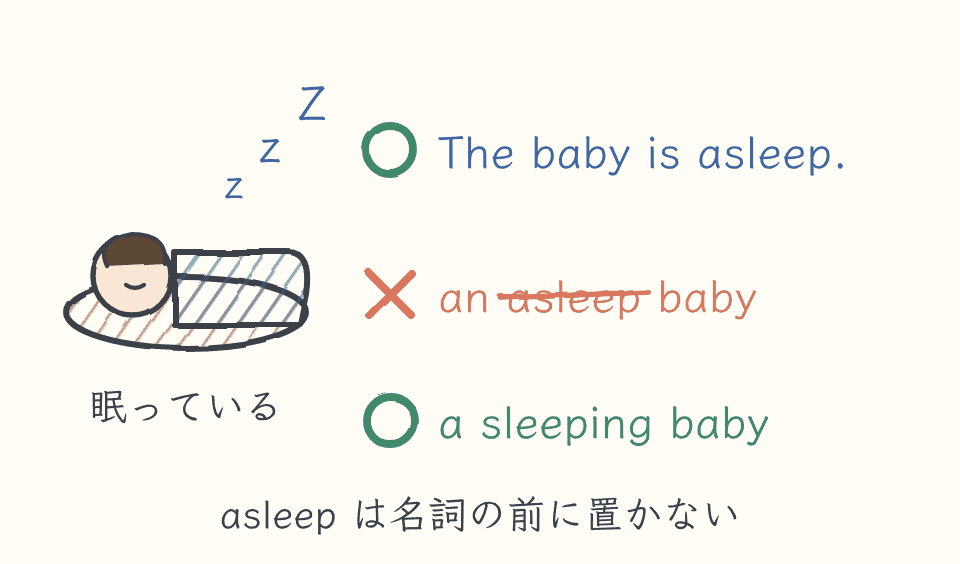
The baby is asleep.
赤ちゃんは眠っている。
Is the fish still alive?
その魚はまだ生きていますか。
This is the main reason for the delay.
これがおくれのおもな理由です。
「眠っている赤ちゃん」は × an asleep baby ではなく a sleeping baby と言います。
2数字 + 名詞 のハイフン
〈数字 + ハイフン + 名詞〉で、名詞の前に置く形容詞をつくれます。このとき名詞は単数形のままです。
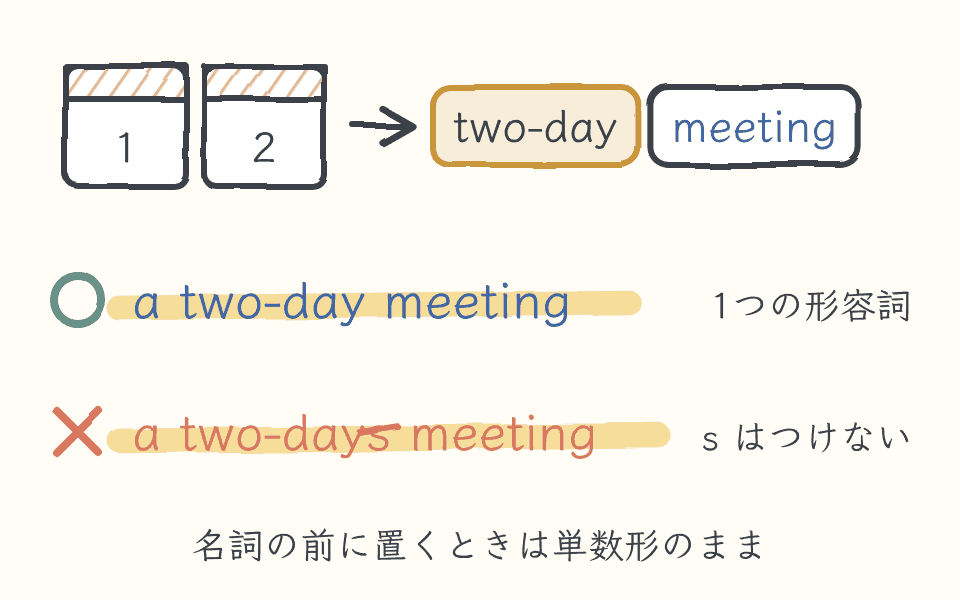
It is a two-day meeting.
それは2日間の会議です。
She has a ten-year-old son.
彼女には10歳の息子がいます。
The station is a five-minute walk from here.
駅はここから歩いて5分です。
The flight had a three-hour delay.
その便は3時間おくれた。
× a two-days meeting。名詞の後ろに置くときは、The meeting lasts two days. のように複数形にします。
3-ing と -ed の感情の形容詞
-ing の形は「(人を)〜させるような」で、物や事について使います。-ed の形は「(人が)〜させられた=〜している」で、ふつう人の気持ちを表します。
The movie was exciting.
その映画はわくわくする内容だった。
I was excited.
私はわくわくした。
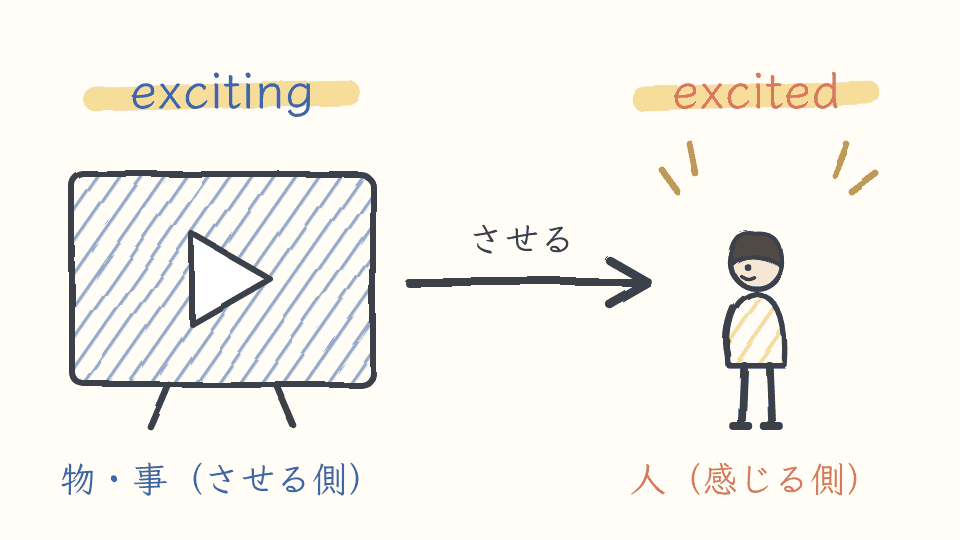
| -ing(物・事が〜させる) | -ed(人が〜する) |
|---|---|
| exciting(わくわくさせる) | excited(わくわくしている) |
| surprising(おどろくべき) | surprised(おどろいている) |
| boring(退屈な) | bored(退屈している) |
| disappointing(がっかりさせる) | disappointed(がっかりしている) |
| tiring(つかれさせる) | tired(つかれている) |
The result was surprising.
その結果はおどろくべきものだった。
Many fans were disappointed with the result.
多くのファンがその結果にがっかりした。
4後ろから修飾する形容詞
something、anything、nothing などは、形容詞を後ろに置きます。また、形容詞にほかの語句がついて長くなるときも、名詞の後ろに置きます。
I want something cold to drink.
何か冷たい飲み物がほしい。
Is there anything wrong with the machine?
その機械にどこかおかしいところがありますか。
She was carrying a bag full of books.
彼女は本がいっぱい入ったかばんを持っていた。
5人を主語にしない形容詞
possible(可能な)、convenient(都合がよい)、necessary(必要な)などは、ふつう人を主語にしません。It is … for 人 to 〜 の形や、物・時を主語にして使います。
Is it possible for you to finish it by noon?
正午までにそれを終えることはできますか。
Would Friday be convenient for you?
金曜日はご都合がよろしいですか。
It is necessary for us to check the data again.
私たちはデータをもう一度確かめる必要がある。
6名詞と形容詞の組み合わせ
日本語の「高い・安い」「多い・少ない」を、そのまま英語にすると不自然になることがあります。名詞ごとに、決まった形容詞と組み合わせます。ニュースでよく出る組み合わせを覚えましょう。
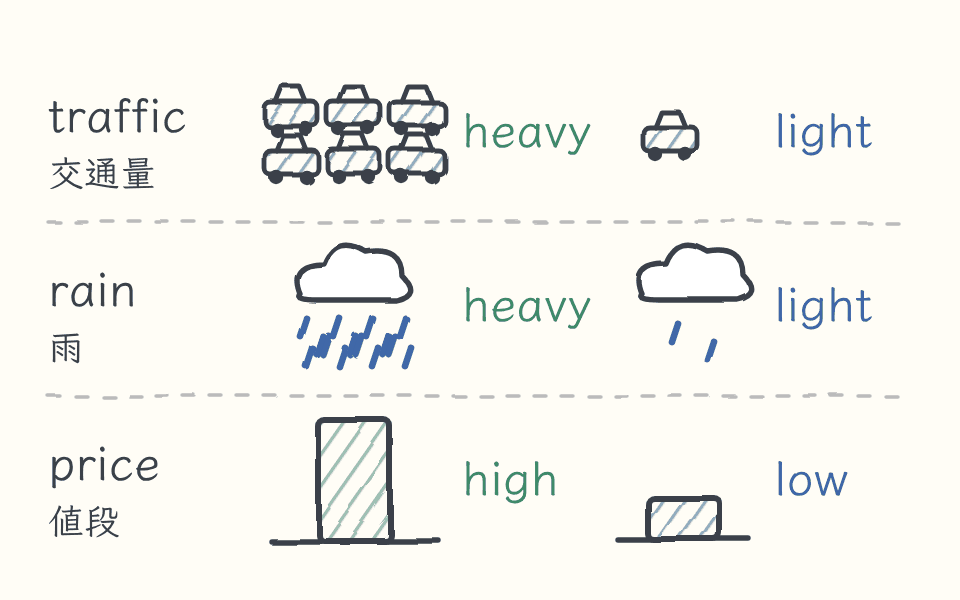
| 名詞 | 「高い・多い」 | 「低い・少ない」 |
|---|---|---|
| price(値段) | high | low |
| salary(給料) | high | low |
| population(人口) | large | small |
| traffic(交通量) | heavy | light |
| rain(雨) | heavy | light |
Prices are high in this city.
この市は物価が高い。
The town has a small population.
その町は人口が少ない。
The traffic was heavy this morning.
今朝は道路がとても混んでいた。
7よくある間違い
| × | ○ | ポイント |
|---|---|---|
| a two-days meeting | a two-day meeting | 数字+名詞の形容詞は単数形 |
| I was very boring.(退屈した、のつもり) | I was very bored. | 人の気持ちは -ed |
| cold something to drink | something cold to drink | something は形容詞を後ろに |
| I am convenient on Friday. | Friday is convenient for me. | convenient は人を主語にしない |
| The price is expensive. | The price is high. | price には high / low |
| an asleep cat | a sleeping cat | asleep は名詞の前に置かない |
8確認問題
( )に入る語を選びなさい。The game was very( exciting / excited ).
答えを見る
exciting
試合(物・事)が人をわくわくさせるので -ing です。
誤りを直しなさい。We stayed at a three-stars hotel.
答えを見る
We stayed at a three-star hotel.
数字+名詞で形容詞にするとき、名詞は単数形です。
並べかえなさい。Is there( interesting / anything )in today's paper?
答えを見る
Is there anything interesting in today's paper?
anything は形容詞を後ろに置きます。
( )に入る語を選びなさい。The population of this city is very( many / large ).
答えを見る
large
population には large / small を使います。
英語にしなさい。「来週の月曜日はご都合がよろしいですか。」(convenient を使って)
答えを見る
Would next Monday be convenient for you?
convenient は人ではなく日時を主語にします。Is next Monday convenient for you? でもかまいません。
9ニュースで出てきた形容詞の語法
ニュースでは、a three-hour delay(3時間のおくれ)や a two-day meeting(2日間の会議)のように、〈数字+名詞〉の形容詞がよく使われます。
It is a two-day meeting, on October 30 and 31.
10月30日と31日の、2日間の会合です。
10月30日と31日の、2日間の会合です。two-day は「2日間の」。数字と day をハイフンでつなぐと、名詞の前に置けます。
Foreign ministers from the Group of 20 major economies gathered in Atlanta, Georgia, for a two-day meeting that ends on October 31.
主要20か国・地域、G20の外相が、10月31日までの2日間の会合のため、ジョージア州アトランタに集まりました。
主要20か国・地域、G20の外相が、10月31日までの2日間の会合のため、ジョージア州アトランタに集まりました。the Group of 20 major economies は、G20の正式な言い方です。economy は「経済」のほかに、「経済の単位としての国や地域」という意味でも使います。