話法
人のことばを「そのまま」伝える直接話法と、「自分のことばで」伝える間接話法
1直接話法と間接話法
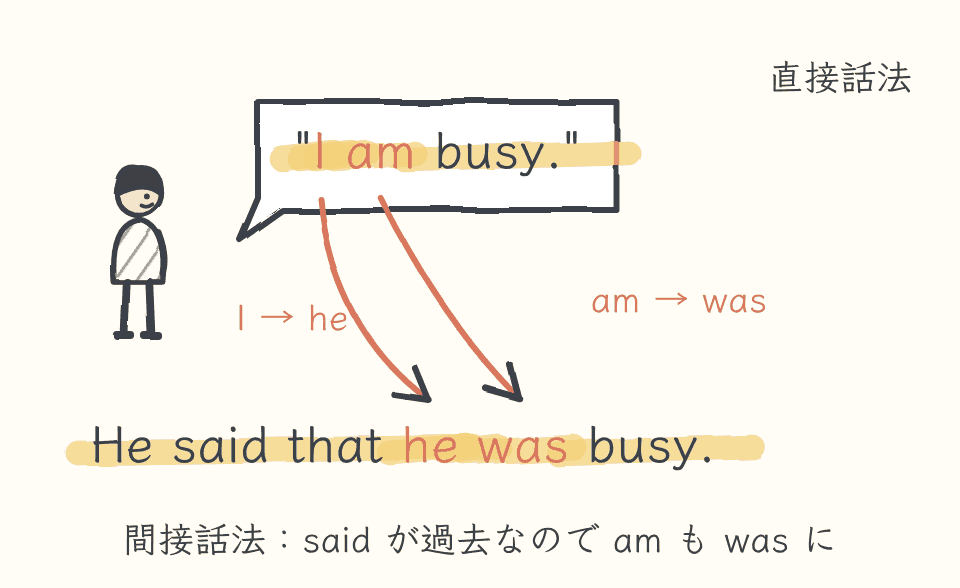
人の言ったことを伝える方法は2つあります。直接話法は、言ったことばを引用符(" ")に入れてそのまま伝えます。間接話法は、話し手の立場から自分のことばに直して伝えます。間接話法では、代名詞・時制・時や場所を表す語を、伝える人の立場に合わせて変えます。
He said, "I am busy."
彼は「ぼくは忙しい」と言った。
He said that he was busy.
彼は忙しいと言った。
直接話法の I(彼自身)は、間接話法では he になります。また、伝える動詞 said が過去なので、am は was になります。これを時制の一致といいます。
2平叙文の言いかえ(say と tell)
ふつうの文(平叙文)は say (that) 〜 で伝えます。だれに言ったかを示すときは、直接話法の said to 人 を、間接話法では told 人 (that) 〜 にします。that はよく省かれます。
| 直接話法 | 間接話法 | 変えるところ |
|---|---|---|
| She said, "I like this song." | She said that she liked that song. | I → she、like → liked、this → that |
| He said to me, "I will help you." | He told me that he would help me. | said to me → told me、you → me、will → would |
| Tom said, "My sister is sick." | Tom said that his sister was sick. | my → his、is → was |
She said, "I like this song."
彼女は「私はこの歌が好き」と言った。
She said that she liked that song.
彼女はその歌が好きだと言った。
He said to me, "I will help you."
彼は私に「君を手伝うよ」と言った。
He told me that he would help me.
彼は私に、手伝ってくれると言った。
3時制の一致
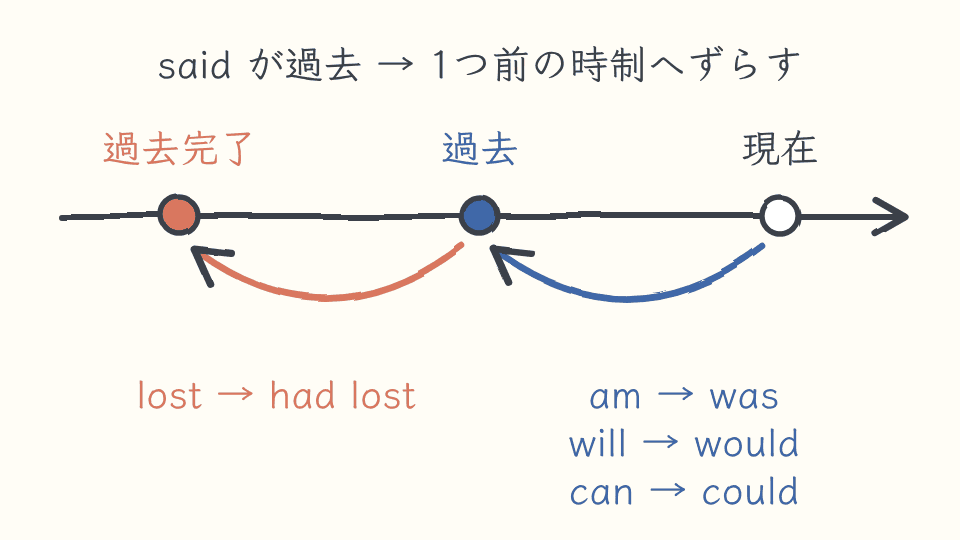
伝える動詞(said・told など)が過去のとき、that 節の中の動詞はふつう1つ前の時制にずらします。
| 直接話法の中 | 間接話法(時制の一致) |
|---|---|
| 現在形(am / is / like) | 過去形(was / liked) |
| 過去形・現在完了(lost / have lost) | 過去完了(had lost) |
| will / can / may | would / could / might |
| must(〜しなければならない) | must または had to |
Mary said that she was hungry.
メアリーはおなかがすいていると言った。(← "I am hungry.")
He said that he had lost his key.
彼はかぎをなくしたと言った。(← "I lost my key.")
She said that she could swim well.
彼女は上手に泳げると言った。(← "I can swim well.")
今も変わらない事実や、言った内容が今も当てはまるときは、時制をずらさないこともあります。
Our teacher said that the earth goes around the sun.
先生は、地球は太陽のまわりを回っていると言った。
She said that she lives in Osaka.
彼女は大阪に住んでいると言った。(今も住んでいる)
4時・場所を表す語の変化
間接話法では、言われた時・場所から見た語を、伝える時・場所から見た語に変えます。
| 直接話法 | 間接話法 |
|---|---|
| now | then |
| today / tonight | that day / that night |
| yesterday | the day before / the previous day |
| tomorrow | the next day / the following day |
| last week | the week before / the previous week |
| 〜 ago | 〜 before |
| here | there |
| this / these | that / those |
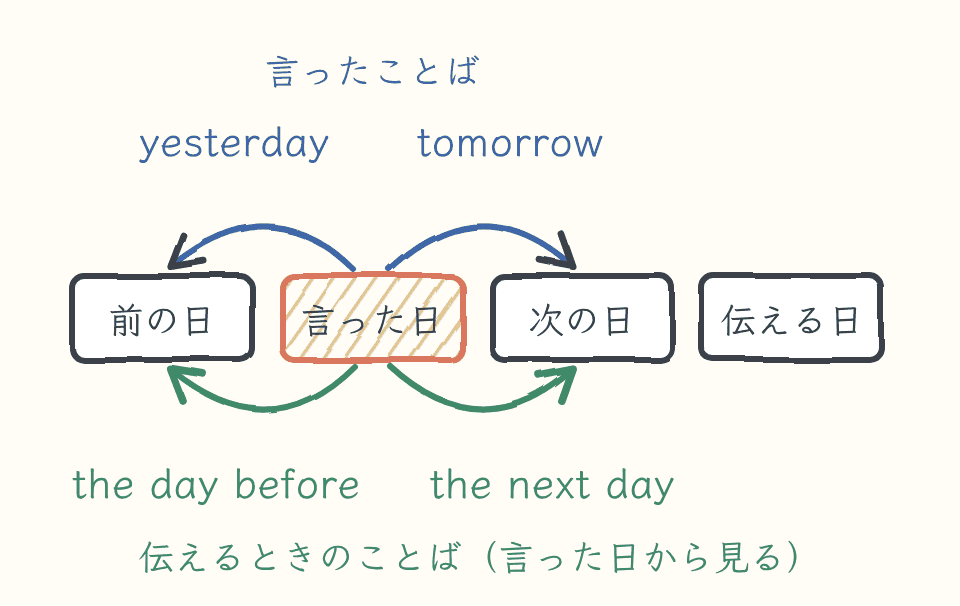
He said that he was leaving the next day.
彼は次の日に出発すると言った。(← "I'm leaving tomorrow.")
She said that she had met him the day before.
彼女は前の日に彼に会ったと言った。(← "I met him yesterday.")
He said that he would wait there.
彼はそこで待つと言った。(← "I will wait here.")
She said that she was busy that day.
彼女はその日は忙しいと言った。(← "I'm busy today.")
同じ日のうちに同じ場所で伝えるなら、tomorrow や here をそのまま使ってかまいません。機械的に変えるのではなく、伝える人の立場から考えましょう。
5疑問文と命令文の言いかえ
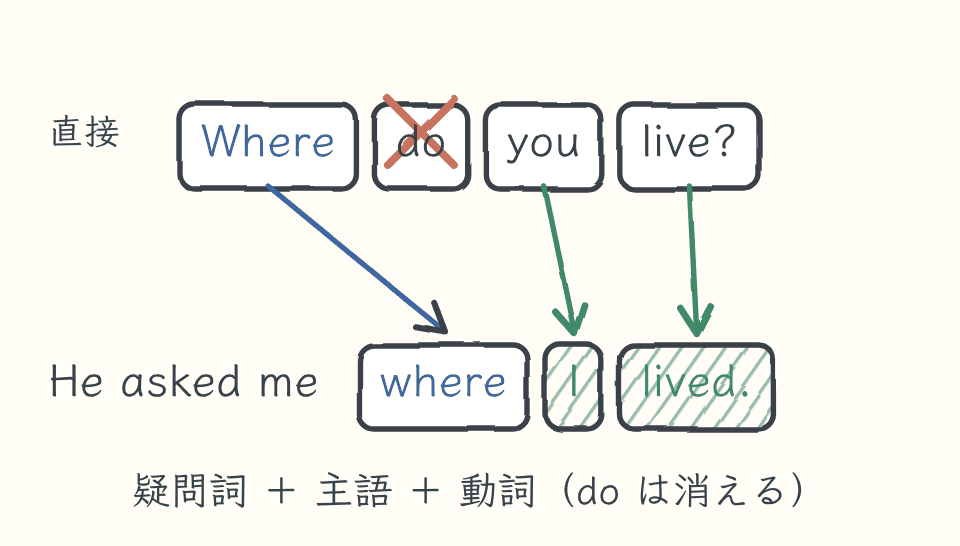
疑問文は ask を使います。Yes / No で答える疑問文は ask (人) if / whether 〜、疑問詞のある疑問文は ask (人) 疑問詞 + 主語 + 動詞 にします。どちらも、ふつうの文の語順になることに注意しましょう。命令文は tell 人 to 〜、依頼(Please 〜)は ask 人 to 〜、否定の命令文は tell 人 not to 〜 で表します。
| 種類 | 直接話法 | 間接話法 |
|---|---|---|
| Yes / No 疑問文 | He said to me, "Are you hungry?" | He asked me if I was hungry. |
| 疑問詞の疑問文 | He said to me, "Where do you live?" | He asked me where I lived. |
| 命令文 | She said to me, "Clean your room." | She told me to clean my room. |
| 否定の命令文 | He said to us, "Don't run." | He told us not to run. |
| 依頼 | He said to me, "Please open the window." | He asked me to open the window. |
He asked me if I was hungry.
彼は私に、おなかがすいているかとたずねた。
She asked me whether I had finished my homework.
彼女は私に、宿題を終えたかどうかたずねた。
He asked me where I lived.
彼は私に、どこに住んでいるのかたずねた。
She asked me what time it was.
彼女は私に何時かとたずねた。
My mother told me to clean my room.
母は私に、部屋をそうじするように言った。
The teacher told us not to run in the hallway.
先生は私たちに、ろうかを走らないように言った。
He asked me to open the window.
彼は私に、窓を開けてくれるようたのんだ。
6ニュースの中の話法
ニュースでは、発表や発言を間接話法で伝えることがとても多く、said・told reporters(記者団に語った)・asked などがよく使われます。that は省かれることがよくあります。まだ先のことなら、next spring のような語はそのまま使われます。
The minister said that the government would raise the minimum wage.
大臣は、政府が最低賃金を引き上げると述べた。
The police told reporters that the man had been arrested.
警察は記者団に、その男が逮捕されたと語った。
The mayor said the new bridge would open next spring.
市長は、新しい橋は来年の春に開通すると述べた。
A spokesperson said the company was looking into the problem.
広報担当者は、会社がその問題を調べていると述べた。
Officials asked residents to stay indoors.
当局は住民に、屋内にとどまるよう求めた。
7よくある間違い
| × まちがい | ○ 正しい形 | ポイント |
|---|---|---|
| He said me that he was busy. | He told me that he was busy. | say は「人」を直接目的語にとらない |
| She asked me where did I live. | She asked me where I lived. | 疑問詞のあとはふつうの語順 |
| He asked me that I was hungry. | He asked me if I was hungry. | Yes / No 疑問文は if / whether |
| The teacher told us don't run. | The teacher told us not to run. | 否定の命令文は tell 人 not to 〜 |
| He said that he will come the next day. | He said that he would come the next day. | 主節が過去なら、ふつう will → would |
8確認問題
間接話法にしなさい。He said, "I am happy."
答えを見る
He said that he was happy.
間接話法にしなさい。He said to me, "I will call you tomorrow."
答えを見る
He told me that he would call me the next day.
said to me → told me、tomorrow → the next day。
間接話法にしなさい。She said to me, "Where are you going?"
答えを見る
She asked me where I was going.
疑問詞のあとはふつうの語順。
間接話法にしなさい。My father said to me, "Don't stay up late."
答えを見る
My father told me not to stay up late.
( ) に入る1語を書きなさい。He asked me ( ) I liked sushi.(← "Do you like sushi?")
答えを見る
if
whether でも正解。
直接話法にしなさい。She told me that she was busy.
答えを見る
She said to me, "I am busy."
9ニュースで出てきた話法
この単元に関係する英文がニュースに出てきたら、ここに自動で追加されます。